


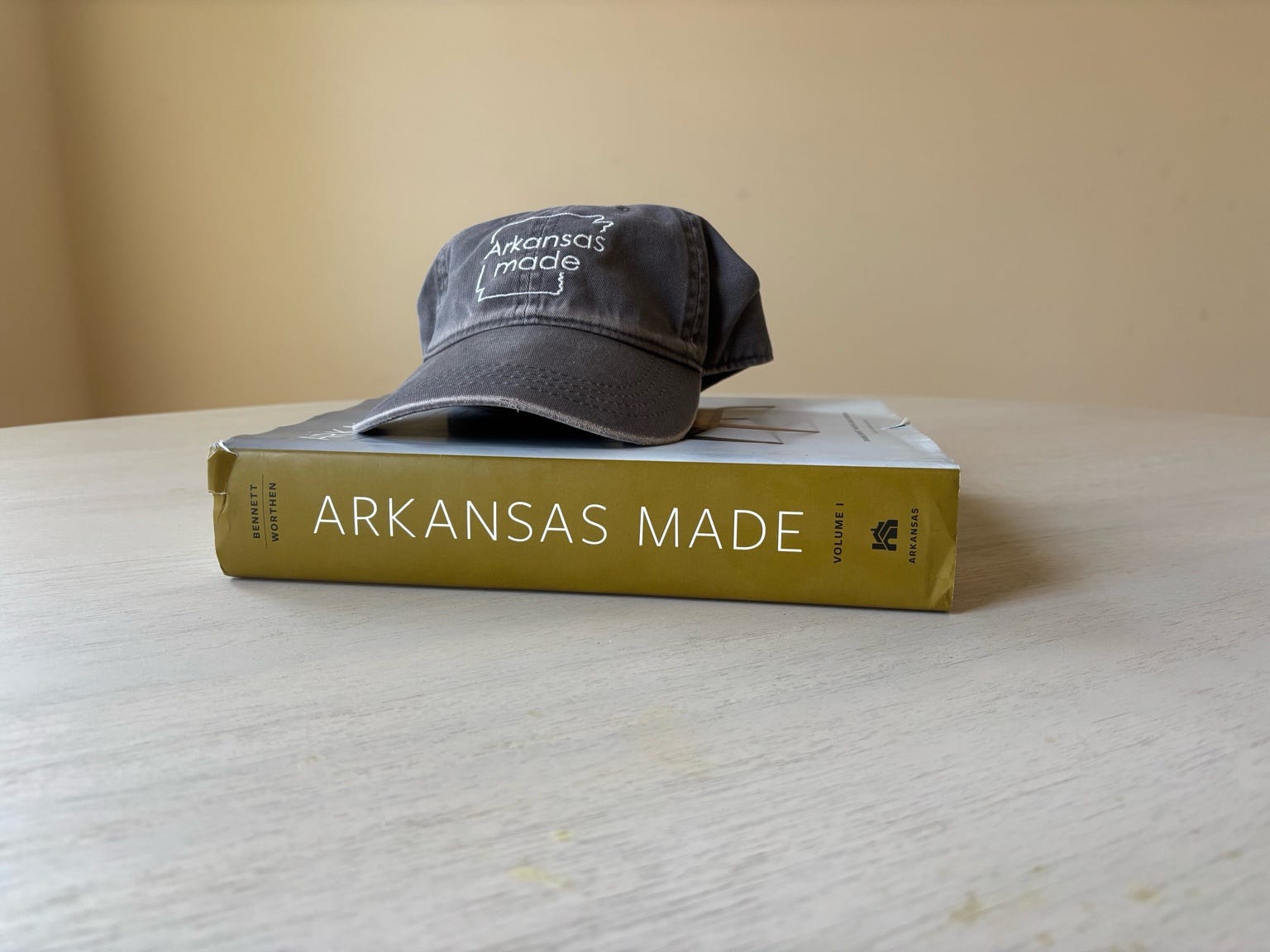
Recently, I was listening to a podcast debate (starts at minute 39) whether Arkansas should even be allowed to have this many people with national ambitions. The comment was meant as a joke. But one of the panelists pushed back with something more interesting. He said Arkansas produces a different kind of education. Not academic but Social. The proximity between regular people and the top of the political pyramid is closer there than almost anywhere else. The governor actually knows her constituents. The panelist proposed that Walmart money created exposure that neighboring southern states don’t have. He said there’s something going on down there that allows people to cut through nationally. He couldn’t quite name it.
I laughed. And then I thought about it for a long time. It reminded me of a story when I noticed that maybe there was something going on in my homestate that allowed me to cut through nationally academically, then in the financial services, then nonprofit, and now venture capital industries.

A few years ago, I was having a conversation with an advisory client who was the patriarch of an Oklahoma family office. He’d made his wealth in oil and gas, was about ten years older than me, and was deliberately looking for someone with my profile: raised in the South with those values, trained professionally on the coasts. I had read Boomtown before we started working together, so I understood something of his world. But it wasn’t until he asked me a simple question that I saw the clear difference between our two upbringings in neighboring states.
He asked what it was like growing up in a state where the president was from.
I paused. Not because I didn’t have an answer. Because I’d never thought of it as a question worth asking. It just was. President Clinton grew up fifty minutes from where I grew up. That was a fact of life, not a point of pride. What he was marking as exceptional had always been, to me, background.
That’s the first thing Arkansas teaches you. Exceptional things can feel ordinary. And ordinary places can produce something the world doesn’t see coming.
The second thing is harder to explain. Arkansas is a genuinely strange state. Not in the way people mean when they use that as a punchline (and I heard plenty of those jokes when I moved to New York for college). Strange in a productive way. The Ozarks and the Delta share the same borders. Hill folk and rice farmers. Old money in Bentonville and generational poverty in Pine Bluff, sometimes within the same county. Walmart wealth alongside some of the lowest median incomes in the country. Clinton and Huckabee. J.B. Hunt trucks and lithium extraction in the southern part of the state. A place where you can hunt both elk and alligator (I’ve done neither, I prefer swimming with allocators) because the geography demands it. The New York Times once called it a schizophrenic state (My favorite article about the peculiarity of my home state). They meant it as an observation. I came to understand it as an education.
Growing up inside that contradiction shapes you in ways you don’t recognize until someone from outside points at them. In high school I was moving between being an athlete, an honor student, and a science nerd, code-switching between those worlds without much conscious thought. That was just life. But what I was actually developing was something more durable: the ability to read rooms quickly, pick up signals others miss, understand how different systems operate and where they secretly connect, and hold multiple truths at once without needing them to resolve cleanly. The weather saying I grew up with was: if you don’t like the weather in Arkansas, just wait a few days. I think that works as a life philosophy too. Conditions shift. You adapt. You don’t panic when the environment changes because you’ve learned it always does. I didn't know it then, but that was preparation.

I was in a meeting recently with a fund manager who built his early career playing competitive online poker. He said the game trained him to see patterns in real time, to notice when something was off and chase it down. He said if you can marry pattern matching with genuine curiosity, you can probably be a venture capitalist.
That landed for me. Because Arkansas is where I got my version of that. Not through poker. Through proximity. In a small, contradictory state, if you’re ambitious and relational, you end up in a lot of different rooms. You learn to connect disparate dots before a headline tells you to. You become comfortable being the different one in any given group. You develop the habit of gathering information from vastly different places and sensing the driving forces underneath before they surface. You become a connector. not because you networked strategically, but because you were raised in an environment where understanding people unlike you was simply the price of entry.
Reading Made in America a few years ago, what struck me about Walton wasn’t the retail strategy. It was his obsessive curiosity. He flew his own plane to small towns to see things directly, before others did. Reading First in His Class, what stayed with me about Clinton wasn’t the politics. It was his memory for people. He understood instinctively that influence comes from making someone feel seen before you try to move them.
Different men. Different flaws. Very different outcomes. Same underlying disposition. Curiosity. Pattern recognition. Deep relational intelligence. A restlessness that wouldn’t stay inside the size of the state.
Arkansas kept producing that. And I think it was producing those things in me long before I had language for any of it.
When I applied to Columbia without knowing anyone who had done it, I didn’t have a blueprint. What I had was a quiet sense that exceptions come from places like this, and no good reason I couldn’t be one of them.
That sense hasn’t left. It didn’t come from nowhere.
It came from a small, strange, contradictory state that keeps making people the world doesn’t see coming.
I’m one of them. Still becoming one, maybe.
Arkansas made that possible. And I don’t take that for granted anymore.
with gratitude,
Earnest IV
Nice read
Your personal experience about the impact of growing up in Arkansas resonated with me. You are clearly a deep thinker, Ernest. You belong in San Francisco, where trailblazing ideas emerge, culture shifts quickly, and public art helps preserve a sense of continuity.
As a child, I experienced desegregation in Houston, and later attended a high school in San Diego where I was one of only ten Black students. Later, I lived in Sweden for ten years. At the time, I did not realize those experiences were teaching me how to read the room and helping prepare me to guide people through the complex sociopolitical, educational, and economic terrain of the modern-day Fairness Paradox.