


I. Every Generation Thought They Had the Story
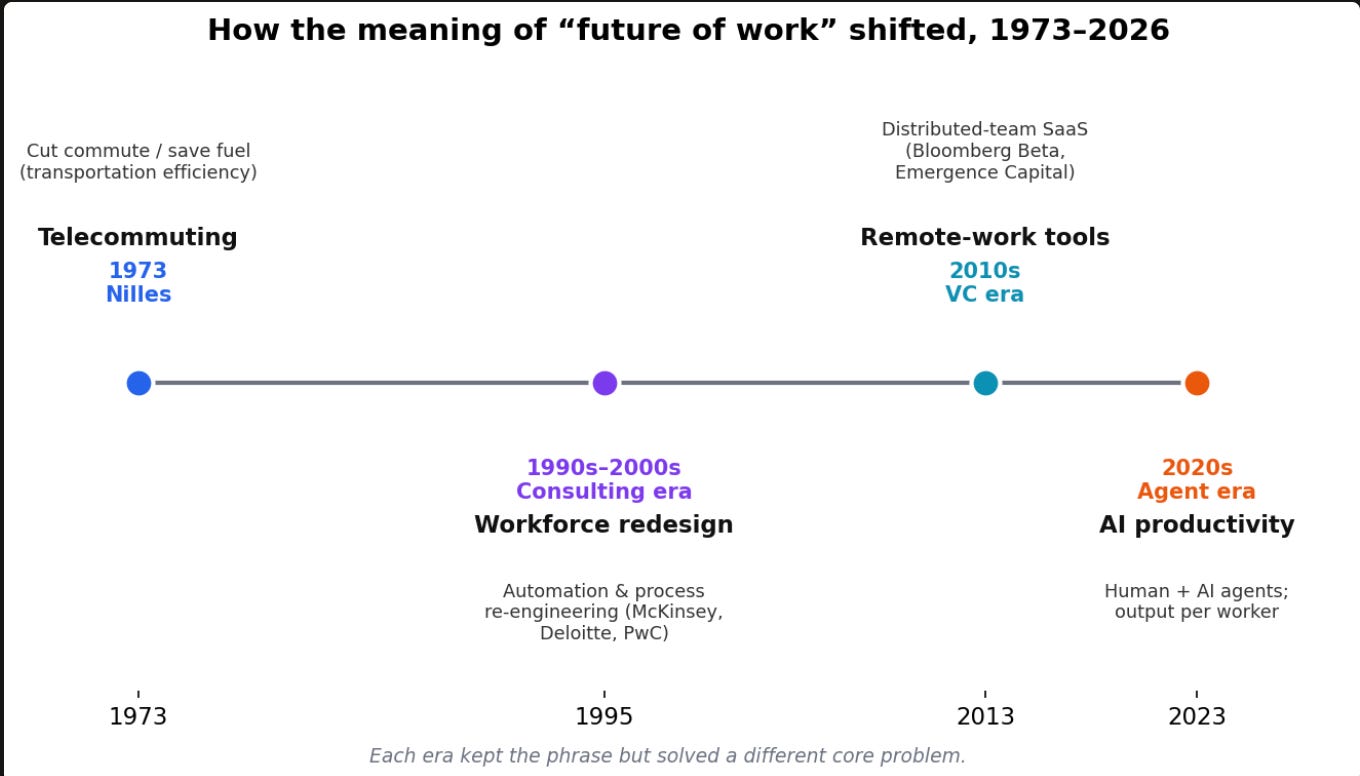
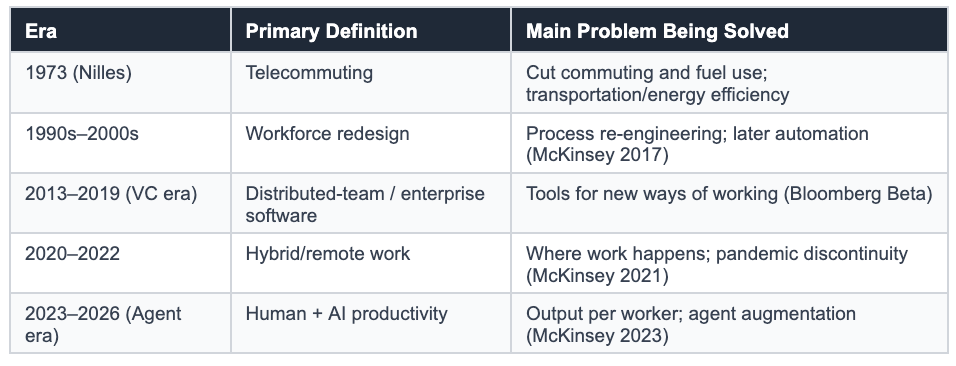
In 1973, a USC physicist named Jack Nilles coined the word “telecommuting.” The original problem he was trying to solve was not talent, not flexibility, not work-life balance. It was the energy crisis. Americans were using too much oil driving to offices. His proposal was straightforward: keep workers closer to home by connecting them to their work electronically. The future of work, in 1973, was about the price of gas.
His catalyzing challenge came from an urban planner’s taunt: “If you can put a man on the moon, why don’t you do something about traffic?” Nilles secured a National Science Foundation grant in 1973, published his Final Report in December 1974, and ran a pilot with an insurance company that cut turnover to near zero and raised productivity 15 percent. The company declined to adopt the model, fearing union-organizing dynamics. As Nilles later recalled: “The experiment was a success. But the company said, no, we’re not going to do that.” For the next thirty years, the dominant frame remained congestion relief, clean air, and post-9/11 business continuity, not personal flexibility.
Then the internet arrived and the conversation accelerated. By the late 1990s and early 2000s, the promise of technology-enabled flexibility was everywhere. The vision was expansive: people would work from wherever they chose, hierarchies would flatten, knowledge would flow freely across organizations, and geography would stop being a constraint on talent.
When the major consultancies adopted the phrase in 2017-2018, they still meant automation, not location. McKinsey Global Institute’s landmark “A Future That Works” (January 2017) estimated about half of all work activities could be automated with then-current technology, equivalent to roughly $15 trillion in global wages. Deloitte’s 2017 Human Capital Trends framed the “augmented workforce” driven by AI systems, robotics, and cognitive tools. PwC’s “Workforce of the Future” (2018) built four scenario worlds around automation, AI, demographics, and globalization. None of the three flagship reports centered location flexibility. That reframing came only after 2020.
As a venture investment category, “future of work” was claimed early by Bloomberg Beta, launched in June 2013 with $75 million, describing itself as “the first VC to declare a focus on the future of work and the first to say we wanted to invest in AI.” Managing Partner Roy Bahat defined it broadly, “beyond productivity tools, to how work can serve everyone,” and pushed back when the press collapsed it into remote-work software alone. Emergence Capital similarly developed theses spanning coaching networks, the deskless workforce, and deep collaboration, noting in 2018 that less than 1 percent of venture investment had gone to deskless-worker technology despite that group representing 80 percent of the global workforce.
Somewhere around 2015 to 2019, the phrase became a VC category, a conference theme, a consulting practice, and ultimately a shorthand that meant: remote work tools, flexible scheduling, and the Slack-ification of the enterprise.
All of that was real. None of it was the full story.
I think about this now because the phrase is being used again, and again it is being used to describe something smaller than what is actually happening. The people who got it partially right in 1973, in 1999, in 2016, were pointing at a real direction but describing the first visible symptom rather than the underlying condition. The underlying condition is this: what work actually is has always been in the process of changing, and the changes have always been larger and slower and more consequential than anyone predicted while they were happening.
We are still inside that change. It is just that now the technology doing the changing is different in kind, not just in degree.
Era-by-Era Summary
II. Where I Started
In 2007, I was an equity research associate at BMO Capital Markets in New York. My workstation was a desktop. If I needed to work from home, I had a laptop available, but it required a BitLocker decryption sequence before it would open (a security protocol that also functioned, not coincidentally, as a mild deterrent). The office was where work happened, and that felt self-evident to everyone, including me.
Writing a client-facing email back then took me roughly fifteen minutes. Not because I was slow. Because the standards were different, and the process reflected those standards. Every sentence had to be constructed, considered, and reviewed. The email was the work. Its clarity was a direct proxy for the clarity of the thinking behind it. A sloppy email was a sloppy analyst. There was nowhere to hide, and nobody expected anywhere to hide.
Nobody was measuring my output in emails per hour. They were measuring the quality of the thinking those emails carried. The email was just the container. The judgment inside it was the job.
