


Two years ago I spent a lot of money on Replit trying to build a Cerebro, an agentic CRM that would let me blow past Dunbar’s number. My family asked what I was doing. The best answer I had was that it was cool. Vibe coding, just vibes.
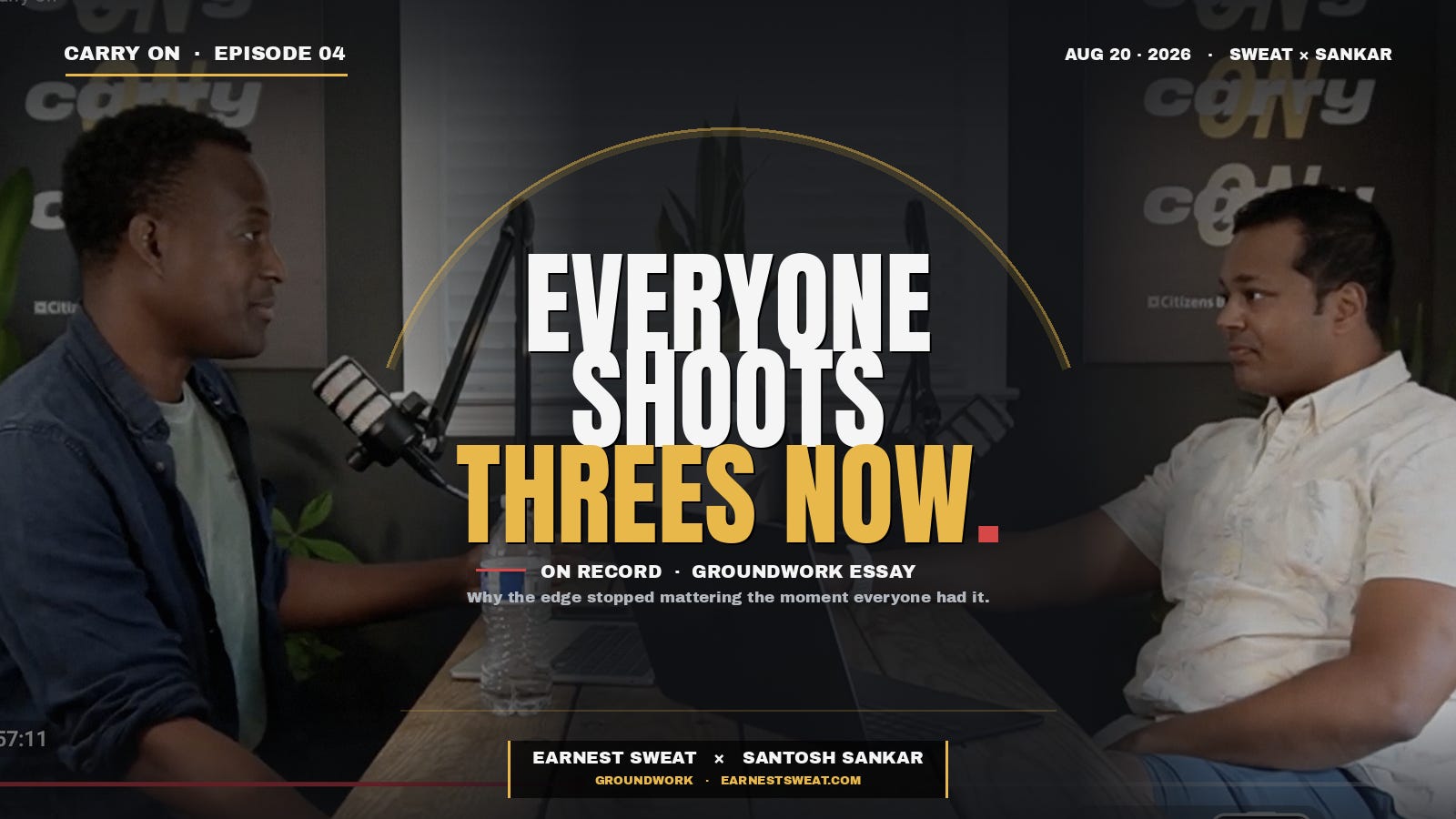
I started that story on episode four of Carry On, and Santosh cut in with the specifics before I got to them. Five hundred plus. Over a weekend. I finished his sentence. That you’re not even using. Everybody building has one of those.
I brought the pattern; Santosh supplied the part I did not have. My list was firms that focused on data, firms that built platform services, firms that specialized in one industry. Each started as a reason an LP should pick you and ended as a line in every deck. What I asked was what happens to whoever shows up late.
He answered with a clock. In the prior cycles, novelty commoditized in roughly one to two fund cycles. He claims that AI accelerates that, because commoditizing defensibility is what AI does to the industries it enters. Then he ran it forward. We are sitting here in 2026; three years ago was 2023, and by his read the cycle has arguably run once already. He kept the hedge and so will I. On adoption, he is not hedging. “You cannot do it.”
I reached for basketball. When the Sloan people let us idiots know that a thirty-five percent three-point shot beats a fifty percent two-point shot, every team started shooting threes. The insight was correct, and it stopped being an advantage the moment the market was corrected. What separated the Warriors was not the math. It was Klay Thompson and Steph Curry, and Draymond Green, who survived the space they opened.
He put it as a maybe rather than a verdict. “If you don’t have anything unique and advantageous without AI in the equation, AI isn’t going to actually bring that to you.”
My framing has been that tools should magnify what you are already great at, by ten or a hundred times. I said it again on air. Santosh took it and added the half I had never stated. “Don’t use AI to help you improve a weakness that might be better done by actually adding to your team.”
That is a hiring rule wearing an AI costume. A gap in your firm is a person-shaped problem. Covering it with a model leaves you mediocre at that thing permanently, with better documentation. I said absolutely, and we moved on. I have chewed on it since. In the same stretch, he described asking his principal what she thought her superpower was, and framed his read as an argument rather than a finding: most funds probably have duplicative superpowers on the team and have done okay anyway.
The thing I keep returning to is the least glamorous. He thinks the skills file will become one of the more important artifacts inside a firm, along with every reference it reaches into. “A lot of how you get AI performant is not different than when you have new hires coming in. You need to document how work is done.”
At Dynamo, an agent drafts the portfolio update and headline numbers, then several people comb it for accuracy and completeness, which frees the quarter for the deep thesis piece. What I liked most is what AI did to his old process docs, some untouched for two years. Some he improved, because a model holds more context than a person. Others he decided did not need to exist, since they only existed to account for a human in the loop. That is operations hygiene in a new hat, and the least copyable thing in the episode.
Where I am still working it out is taste. Santosh asked whether you could teach it to a model. I said I never like to say never with technology, and then I said today, no. I believe both halves and know they do not sit together.
The bigger tension is with my own first episode. Motion is not movement. I argued in July that venture mistakes activity for progress, and spent a good part of this one advocating for activity. Tinkering that changes what you ship is movement. Tinkering that only changes what you use is motion. I am not sure the line holds. I have the Replit receipt.
The moment I keep coming back to landed before the harnesses and the agents. Santosh asked whether it was strange that we had circled back to what our parents were teaching us at eight, nine, ten years old. Just be a good dude. I said being a good person is an advantage, and I meant it as a claim about competitive dynamics, not a sentiment.
Then we spent the back half on harnesses and agents and skills files, and I closed by saying the individual contributor is dead forever. I wrote a version of that in Everyone (and Everything) Is a Manager Now and still think it is right. But we settled the human part first and spent the rest on tools. Either that is the joke, or it is the point.
Listen here: https://carryonpodcast.com/podcast/ai-wont-get-you-access-the-human-skills-that-still-matter-most/
With gratitude,
earn