



Sometimes life feels like a badly written movie. A Tubi movie. You meet a character who seems like they matter, and they never pay off. Then somebody you weren't even interested in walks into a scene and hands you the insight that moves the whole plot. I said some version of that to a friend who runs a climate fund when we caught up in September, and he took it a step further. Meetings follow a power law too, he said. A small share of them are transformational, and you don't get to those without working through the rest of the tail.
That idea ran counter to what every senior investor I’d worked for believed. My former managing partners always asked me two things: 1) Why are you meeting with so many founders who are way earlier than our preferred Series A stage? 2) Why don’t you just meet with your top five deal sourcers?
My friend called the top-five approach a dangerous strategy. His version is breadth first: meet a lot of people, then go deep with the few where there’s real chemistry, and keep mixing in new blood the whole time. I think he’s right, and the movie is why. You usually don’t know who the important character is until much later. That’s how I think about Series A too. I take a lot of meetings and write very few checks, and the ones I write, I want to lead.
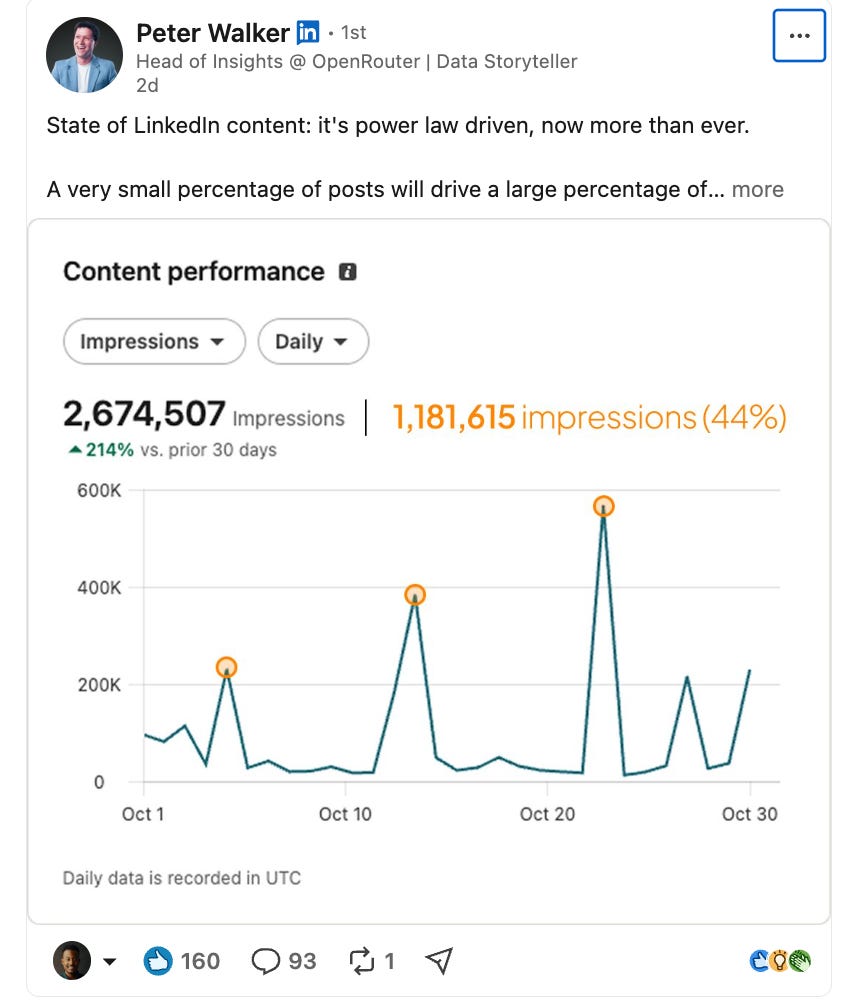
Recently I saw the same idea somewhere that has nothing to do with venture meetings. Peter Walker, head of insights at OpenRouter, posted that LinkedIn is more power law driven than ever. A small share of posts drive most of the impressions, and the middle tier has basically been hollowed out. What I liked was the honesty. He used to think he could tell which posts would land, and now he says he can barely guess. His answer was my friend’s answer in a different arena: the algorithm is going to keep changing, so show up consistently.
Here's the counterargument, and it's coming from the people with the most money. In "On Risk," Jake Gibson at Better Tomorrow Ventures points out that established firms have taken 88.2% of the money US venture funds have raised this year, the highest share PitchBook has ever recorded. Charles Hudson at Precursor picked that up on The Learning Corner and read it through The Unaccountability Machine, a book he says he comes back to all the time. His take was that the system is reflecting what allocators want: fewer decisions and better odds of owning the handful of names that matter. Meeting hundreds of managers and waiting ten years to find out who was right is harder. So they're looking at the same curve the rest of us are, and choosing fewer, bigger swings.
I don’t think they’re wrong, for them. When the perceived outlier is sitting in plain view, like SpaceX or Anthropic, concentrating makes sense. But most of life doesn’t come with the outlier labeled. You don’t know which dinner, which post, or which founder you meet two stages before your stage is going to be the one. When you can’t predict the hit, the person taking the most swings has the edge.
There’s a catch, and Charles named that too. He talked about founders outside SF and New York who show up having done every problem on the old report card, still chasing ARR benchmarks from 2020 and 2021, and he has to tell them, “You were in the wrong chapter.” That’s what reps look like without feedback. They were consistent. They were also playing a game that had already changed.
I’m calling myself out here too. I’ve spent a lot of the last couple of years optimizing for exposure, more rooms and more meetings, when what actually compounds is learning. Take the meeting, figure out what it taught you, use it, then go again. It’s a big part of why I journal most mornings on what I learned the day before.
So yes, life is power law. Take the meeting with the interesting person whose idea you’re not sure about, and post the thing even if the last few went nowhere. Just watch the tape afterward. I still don’t know which meeting this month is going to be the one. That’s kind of the point of taking them.
With gratitude,
Earnest
Earnest, 100%. Availability bias only works for you if you’re willing to accept that you’re in the Grand Slam business not the singles and doubles business. Pure investors are looking for companies and founders that will contribute to the return ON THEIR INVESTED CAPITAL that they’re solving for. VCs, influencers, capital allocators are playing a different game that looks more like protecting their reputation, not offending anybody, betting that the leaders will always be leaders and not messing up. That’s an external locus of focus which, IMHO, comes back to bite you either financially or in regret once you’ve found out that you’ve left your career in somebody else’s hands. Go big or go home also means going big on what you’ve learned and, like riding a bike, you can’t learn anything if you’re too afraid of skinning your knees. Well done.