


Last week, a few people sent me a speech from Davos.
I didn’t watch the video.
I read the transcript.
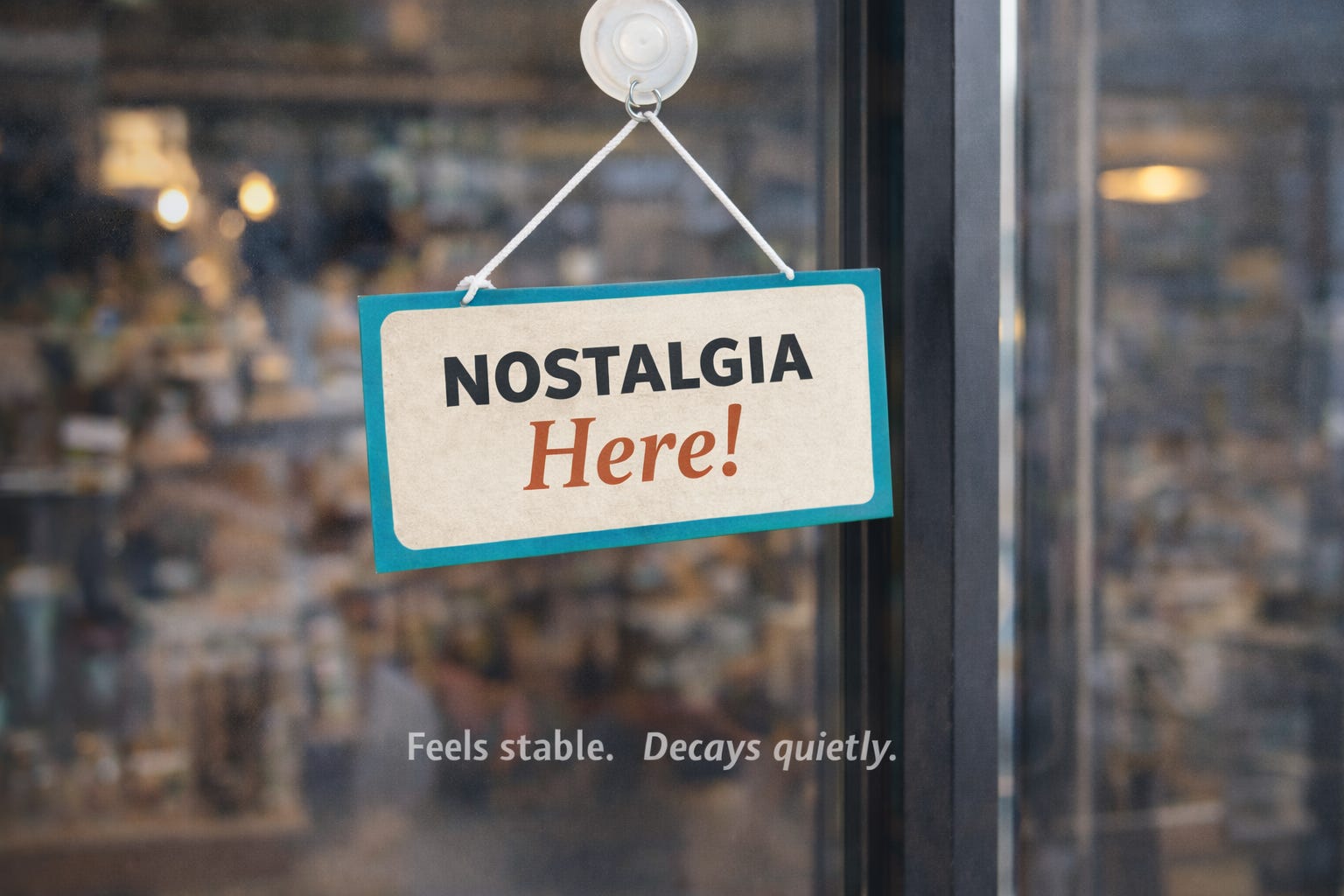
One line stayed with me: Nostalgia is not a strategy.
It sounds obvious. Almost trite.
But the longer I sat with it, the more it felt like a diagnosis.
Not just of geopolitics.
Of venture.
Of investing.
Of leadership.
Of this moment we’re all standing in, whether we want to name it or not.
The speech referenced an essay by Václav Havel, The Power of the Powerless.
Havel tells a story about a greengrocer who hangs a sign in his window every morning:
“Workers of the world, unite.”
The shopkeeper doesn’t believe it.
No one does.
But he puts the sign up anyway.
To avoid trouble.
To signal compliance.
To get through the day.
And because every shopkeeper on every street does the same, the system persists.
Not because it is true.
But because people keep performing it as if it were.
Havel called this living within a lie.
That phrase landed hard.
Because once you see it, you start seeing signs in a lot of windows.
In venture, we have our own versions.
We repeat sourcing and diligence playbooks that worked in 2014 and call it discipline.
We cling to pattern recognition long after the patterns have decayed.
We talk about differentiation while funding sameness.
We say the market will “come back” as if markets have memory or loyalty.
None of this is malicious.
It’s human.
Nostalgia feels like wisdom.
But a lot of the time, it’s just fear with good branding.
The hardest part about this moment is not that things are changing.
It’s that the old stories still half-work.
Brand still opens some doors.
Capital still attracts capital.
Reputation still buys time.
So it’s tempting to keep the sign in the window.
To perform confidence.
To perform certainty.
To perform continuity.
But performance is not the same as truth.
And in investing, living within a lie is expensive.
Being a great investor today requires real adaptability.
Not slogan-level adaptability.
Not “AI-first” adaptability.
But the kind that forces you to re-underwrite your own instincts.
You have to be a real stock picker again.
You have to understand why something is working, not just that it worked before.
You have to get comfortable saying “I don’t know yet” and doing the work anyway.
You have to let go of old signals that no longer predict outcomes.
That’s uncomfortable.
It’s much easier to repeat what once made you feel competent.
But the market does not reward nostalgia.
It rewards intellectual honesty and curiosity.
This is showing up everywhere I look.
In how venture firms are being built.
In how capital is concentrating.
In how trust is being allocated faster and with fewer chances.
In how founders decide who to spend time with.
The old rituals still exist.
But they don’t carry the same weight.
And pretending they do doesn’t make you principled.
It makes you late.
What struck me most about the Davos speech wasn’t its politics.
It was its posture.
A refusal to accept inevitability.
A refusal to confuse realism with resignation.
There was a line about “taking the sign out of the window.”
About naming reality instead of performing comfort.
That feels relevant far beyond geopolitics.
I feel it in venture conversations every week.
I feel it in how founders talk when the cameras are off.
I feel it in how LPs ask questions they didn’t used to ask out loud.
There is turmoil. There is uncertainty.
But I refuse to be hopeless.
Not because hope is naive.
But because hopelessness is passive.
Adaptation is an act of agency.
So is rebuilding.
So is reframing.
So is choosing to create instead of retreat.
That applies to investing.
To firm-building.
To how we show up in our communities.
To how we think about this country and world, even when it’s hard.
We are not obligated to accept decline as destiny.
We are not required to keep performing stories we no longer believe.
Taking the sign down doesn’t mean you have all the answers.
It means you’re willing to tell the truth about the moment you’re in.
And from there, to act.
Slowly.
Imperfectly.
But honestly.
Nostalgia is comforting.
But it is not a strategy.
And I’d rather live in the work of adaptation than in the performance of certainty.
With gratitude,
E