


This quarter, I was on a call with a founder who has built an entire business helping large corporations adopt new technologies. Someone who lives inside innovation. Someone who should feel like the future is right in their hands.
She took a breath and said, “You can be an independent operator with more AI tools than ever, but even I feel overwhelmed. There are so many solutions that discovery itself becomes the job. Signal is hard. Noise is everywhere. And the ironic part is that most of our clients still have not asked us to help with AI procurement. People are curious, but not committed.”
I’ve sat with that statement for the last few weeks. Because if she feels overwhelmed, someone who does this professionally, imagine the emotional load for the typical team.
It captures something deeper than technology. It captures the psychological state of this entire AI cycle. We are swimming in capability and drowning in hesitation.
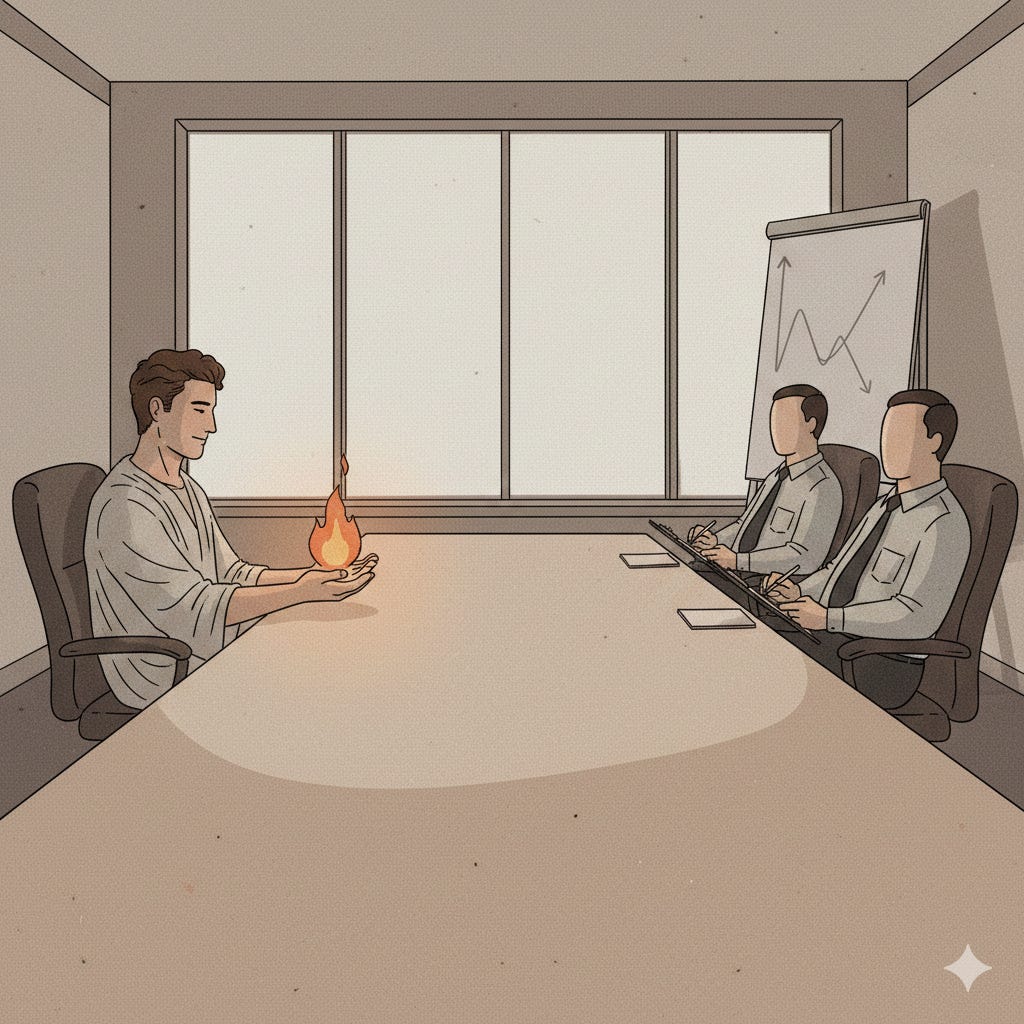
And I keep coming back to a peculiar image in my head. Prometheus sits on one side of a conference room table, holding a small controlled flame, ready to hand it over. On the other side sit the two Bobs from Office Space, clipboards ready, skeptical, evaluating the fire instead of learning how to use it.
That is the state of AI adoption right now. Prometheus meets the two Bobs. Fire meets fear. Possibility meets process. And most people are still deciding which one to trust.

We are not late in the AI era. We are barely out of the warmup lines.
Let’s start with the data because it tells the story with more honesty than the headlines. Bear with me as I put on my old equity research analyst hat.
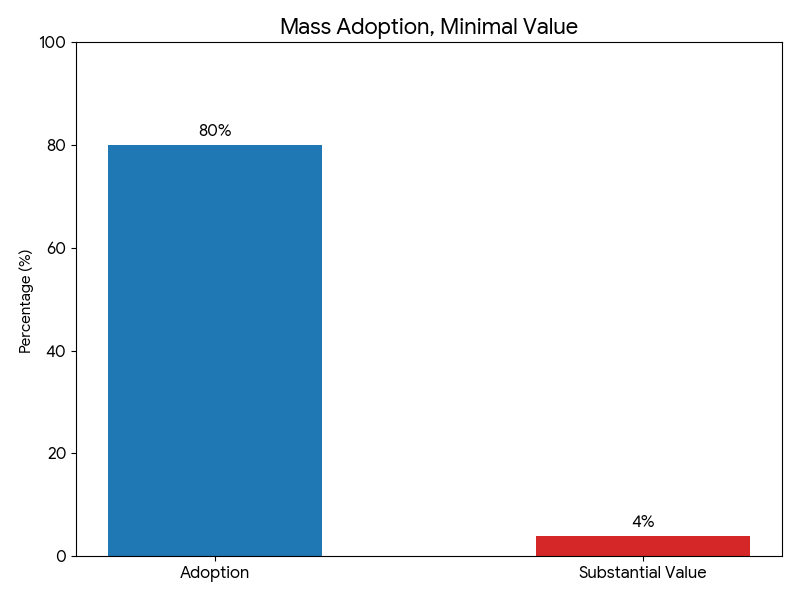
McKinsey says around 78 percent of organizations (from their survey) now use generative AI in at least one business function. That sounds like maturity. But BCG’s research shows only 22 percent of companies have graduated past pilots, and just 4 percent report creating substantial value from AI.
Almost 80 percent are touching the tools. Four percent are winning with them.
That gap is not technical. It is behavioral.
MIT’s writing experiments show AI cuts time by nearly 40 percent and improves quality by around 18 percent. Call center studies show workers get a 14 percent productivity bump with AI assistants, especially newer employees.
The tools work. Humans hesitate.
It is the same on the consumer side. Pew says 34 percent of U.S. adults have used ChatGPT. Around 60 percent encounter AI weekly. But only a third have used a chatbot at all.
Most people feel AI around them. Very few use it intentionally.
Three conversations personified what I was reading
This quarter, I had three conversations that helped me see this moment more clearly. Each one approached the problem from a different angle, but together they formed a kind of triangulation.
I talked to Madison McIlwain, who leads Startup and VC Ecosystem at Vercel, about how much “change underfoot” there has been in both venture and the businesses it has funded over the last six decades. She described this moment as a rare intersection of American dynamism and shifting market foundations.
I talked to Mike MacCombie, one of the best community architects in the ecosystem, about orbits, loops, and why trust is the new distribution. He is living proof that analog-enhanced systems still outperform automated ones when the world feels noisy.
And I talked to Miriam Rivera, cofounder of Ulu Ventures, who responded to my framing of Stresswood as a “virtuous spiral” with an image that has stuck with me ever since. She said it reminded her of Superman reversing the spin of the Earth. It clarified what I’ve been building without fully naming it.
Three different people. Three different perspectives. And all of them pointed to the same idea: the real bottleneck in AI adoption is not the technology. It is the human condition that it is landing on.
AI is arriving in a K-shaped world
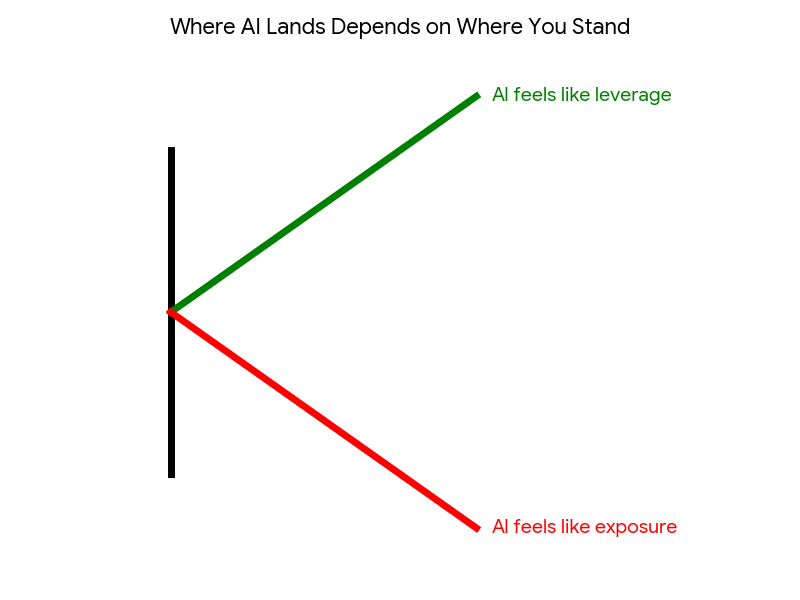
This is the piece people underestimate. AI is not landing in a flat, stable economy. It is landing inside a K-shaped economy where some groups feel secure, and others feel exposed.
