


In venture, when a thesis starts to play out, you don’t write a new memo. You make a follow-on investment. Consider this a follow-on field note.
Two months ago I wrote that the refinery was arriving: that data had spent twenty years as unrefined crude because nobody had built the pipelines, the tankers, or a market price for the barrel. This week the barrel got a price. Google just won the bankruptcy auction for Spirit Airlines’ enterprise data, agreeing to pay $10 million and outbidding Mercor at $7.5 million. Roughly 100 million emails, 500 million Teams messages, the code, the workflows. Decades of operational exhaust from a company once worth $6 billion, sold off right alongside the gate slots.
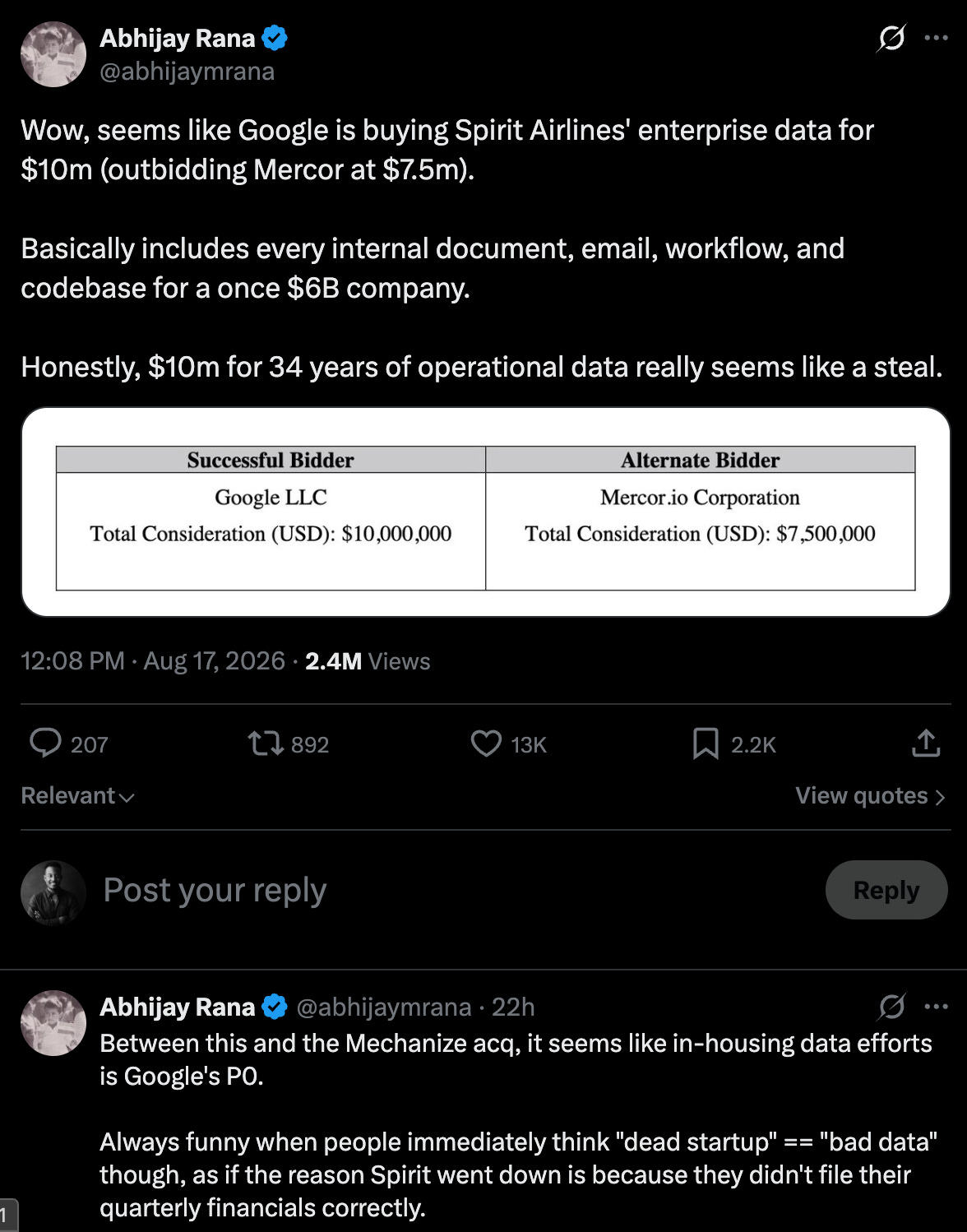
Corporate development keeps finding new things to buy. First it was buy the product for synergies. Next, it was acqui-hires: buy the team, shut down the product. Then firms got acquired for their Rolodex, if you remember what a Rolodex is. Now companies are being bought for their data. The through line is that what an acquirer actually wants is rarely what's on the balance sheet.
If the auction feels like a one-off, the numbers say otherwise. Zach Bratun-Glennon at Gradient estimates the labs are spending $10 to 15 billion a year on expert-generated training data, $1.5 million a day at a single vendor, in an industry that did not exist 24 months ago. Gradient’s own view is that the headline run rates understate the category by three to five times. Zach’s sharpest point has stuck with me: the gap between models is being purchased, not trained. Compute you can rent. Techniques get published. Data bought exclusively compounds inside one org and never diffuses.
The supply side is organizing just as fast. I caught up with an investor friend today whose firm backed a startup that winds down companies. The original business was closing companies cleanly. The new product is acquiring the digital footprint of every company they close, scrubbing the PII (Personally Identifiable Information), and selling it to the foundation labs. Demand is outrunning their hiring, and word is the labs want to go straight to the source. Because a dead company is not dead data. Spirit did not collapse because its data was bad. That archive is a complete record of how an airline actually ran.
How long does this window stay open? I honestly don’t know. But while it is, there is real opportunity for three groups: the AI data-training companies brokering and refining the supply, the wind-down and liquidation startups sitting closest to it, and private equity, which is holding distressed assets with a line item nobody ever priced. And because these are data deals, not equity deals, you don’t need a fund or a license to be in the flow. Brokers, scouts, and service shops eat here too.
There is no playbook yet. Nobody agrees on how to value a company’s data, how to diligence it, how to clean it, how to officially onboard it, or even who owns it. Data rights don’t show up in a term sheet. That is exactly what the early innings of an asset class look like: no comps, no standards, every deal cut from scratch. The refinery arrived in June. The traders showed up in August.
With gratitude,
earn