


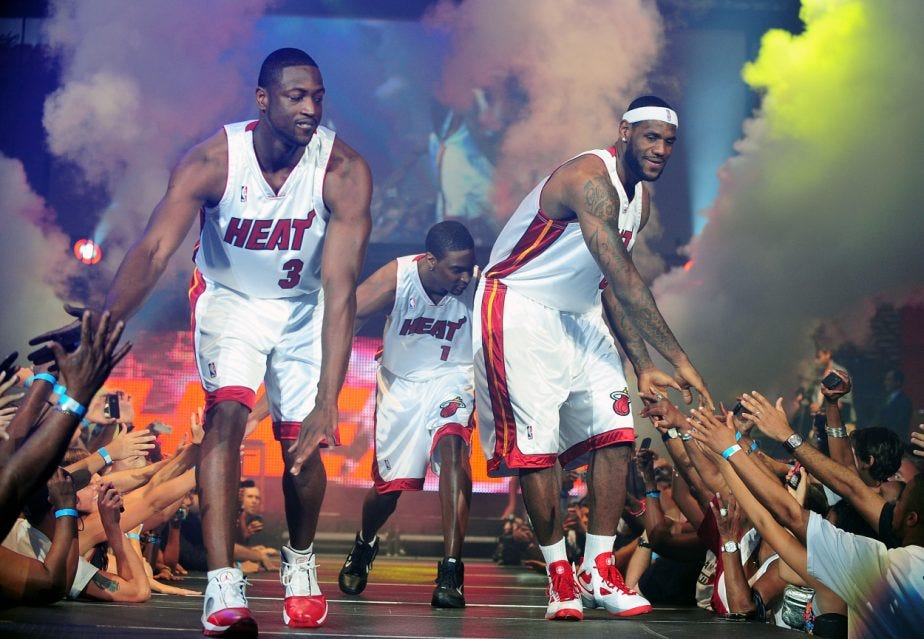
In the summer of 2011, the Miami Heat had a welcome party for their three free agent signees, Dwyane Wade, Chris Bosh and of course LeBron James. James had recently made “the decision” to leave his original team, the Cleveland Cavaliers, for a chance to win the championship in South Beach. The clip that is laughably used to mock this moment in NBA history is when LeBron responds to the question, ‘how many titles can this team win?’ He responded, “not 1, not 2, not 3, not 4…”, eventually tailing off around 8.
They won 2 titles. Which is a hard achievement. But when your expectation is so high, 2 titles is “not 5, not 6, …” and feels like a failure. Even at the time it felt like the Miami Heat players and fans were literally celebrating the offseason like it was the championship parade.
And for a while now something similar has been going on in venture capital. Some misplaced sense of achievement. This has been sitting with me after a stretch of conversations with founders, pre-seed and seed investors, and a steady diet of consolidation headlines.
The fear is not about losing. The fear is about ‘winning’ the wrong way.
There is a moment in early-stage venture that looks like a breakthrough and is actually a trap. A marquee firm comes downstream, sees something they like, and writes a check that skips two stages of price discovery. The round closes at a number that requires everything to go right. The founder celebrates. The seed investors celebrate. And somewhere underneath all of that, quietly, the outcome distribution narrows.
That’s the kingmaking problem nobody talks about loudly. The brand-name firms have enough momentum capital and enough platform pull to set a valuation that the market has to treat as real. Which means the founder is now playing a different game than they signed up for. And the early investors, who did the hard work of finding them before anyone else was paying attention, are now along for a ride they didn’t choose.
A well-capitalized company raises at a number that requires generational scale to justify, stumbles on product-market fit, and then has to pivot the entire thesis just to keep the lights on. Meanwhile, a scrappier competitor, operating with less runway and more discipline, is quietly winning on the ground. The first company raised 10 to 20 times more and still lost.
The math on this is not complicated, but the psychology of it is hard. More capital feels like more options. It buys time, it buys talent, it buys distribution. But it also buys obligation. The moment you take money at a valuation you have not earned, you stop being a company navigating toward product-market fit and start being a company defending a number. Those are very different jobs. The first one leaves room to learn. The second one does not.
What I keep coming back to is how much of this is a timing problem. The capital is not the mistake. The sequencing is. Raise too much, too early, before you know what is actually working, and you lose the middle. The good-not-great outcomes, the ones that still build real companies and return real capital, mostly disappear. You are either returning the fund or you are a cautionary tale.
The investors I keep learning from are not asking “how do we get to the Series A?” They are asking “what does the Series A make possible, and what does it foreclose?” That orientation tends to produce founders who find fit before they find the big check.
The consolidation headlines keep coming. The mega-rounds keep landing at pre-revenue multiples. The pressure to participate is real on every side of the table. But the companies that feel durable right now are not the ones that raised the most confidence. They are the ones that earned it. They won the right way before anyone was watching.
That’s the only way the foundation holds.
with gratitude,
E