


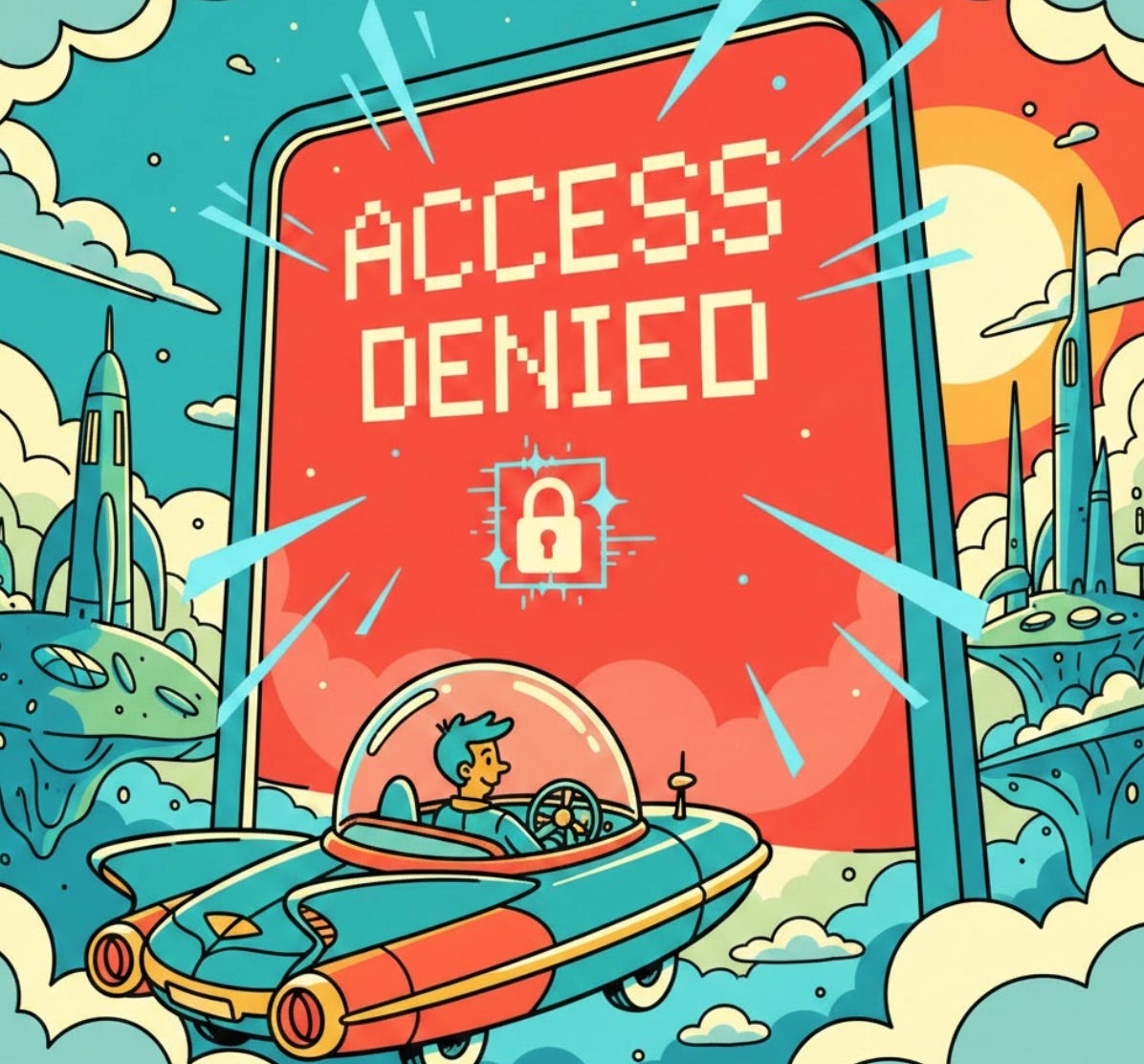
“The internet isn’t getting more open. It’s getting more closed.”
A founder said that to me last week, and it startled me a bit. This wasn’t someone speaking from the outside looking in. He has built AI agent infrastructure twice. Once inside a hyperscaler, and a second time at a large consumer AI company. He is smart, deeply technical, and has lived inside large AI departments with seemingly unfettered access to resources most operators can only dream about. And after all of that, he came to what he described as an inevitable conclusion.
He had seen bot detection everywhere in the cloud, with APIs tightening and firewalls hardening at every turn. His consensus was blunt: enterprises are simply unwilling to punch holes in their systems so that some general-purpose agent can roam freely through their data. They have spent too much protecting it to give it away now.

The dream that has been sold to consumers, builders, and investors was seductive. Autonomous agents floating through the cloud, clicking buttons, pulling data, doing your work while you sleep. One prompt and you could lean back like George Jetson while your digital assistant handled the rest. The reality is something far more humbling. Most of those agents get blocked at the door. I have experienced it myself, trying to use large language models to do research at scale, to automate my daily workflows, to scrape, synthesize, and run multi-step processes. You hit invisible walls faster than you expect. Captchas. Rate limits. Logins. Access restrictions that were never announced but are always enforced.
The models are getting smarter. But the gates are getting stronger. And that tension matters far more than we are willing to admit publicly.
Every major technological shift produces new direct and indirect problems and opportunities. It never produces the predicted utopia or the predicted dystopia. It produces something messier, more complex, and ultimately more interesting. The closing internet is one of those moments.
From Netflix to Walled Gardens
Remember when everything was on Netflix? One login, infinite content, frictionless distribution. You could share it with a few friends and feel like you had unlocked the entire history of television. Then Disney pulled Marvel. HBO pulled its catalog. Peacock appeared. Paramount Plus. Apple TV. Everyone built their own platform because they eventually realized that distribution without ownership is a trap. The streaming dream fractured into walled gardens, and now people are paying more for less, navigating five different apps to find one show.
The internet is going through something remarkably similar. Early Web 3.0 4.0 (sorry I’ve lost count) felt genuinely open. SEO arbitrage worked. Scraping worked. APIs were generous, and growth hacks scaled beautifully. Distribution was cheap, data was accessible, and if you were willing to hustle, you could build an audience or a business on top of someone else’s platform without asking permission.
That era is over.
Data is now proprietary and central to a platform’s valuation.
Platforms are defensive. Distribution is pay-to-play.
Access is permissioned.
And AI does not eliminate this dynamic. It accelerates it.
If you are building in 2026, you are not building on an open plain. You are building inside gated communities. The sooner founders accept that reality, the sooner they can design for it instead of fighting it. And that shift in posture leads to one foundational insight that I keep coming back to: in a closing internet, trust becomes infrastructure.
So what do you watch out for? What can a founder do?
