



I grew up watching Jason Kapono light it up at UCLA. Pure flamethrower. McDonald’s All-American. One of those guys who felt destined for NBA stardom from the jump.
But Kapono did something that messed with the projection.
He stayed in college.
He gave scouts more time to watch him. More possessions. More angles. More tape.
Suddenly, he became less of a mystery and more of an open book.
And in the world of sports scouting, an open book gets judged page by page instead of by promise.
Meanwhile, every year, a fresh crop of high school phenoms would step into the draft with a hype halo. Nobody had enough data to disprove the dream. Some became Kobe. Some became LeBron. Some became Sebastian Telfair. Some became Eddie Curry. But the mystery kept them shiny until reality arrived.
Kapono, meanwhile, slipped down the draft board, worked his way through the league, won multiple three-point shootouts, carved out a near-decade-long, successful career and outperformed a lot of the so-called upside bets.
That dynamic has been stuck in my head for seven years in venture.
Because the same thing happens with startups.
The mystery premium vs the mastery discount
We are in a moment where the hottest AI companies look like high school phenoms. They show up to demo day with vibes, velocity and a spreadsheet full of inbound from hyperscalers. The market squints and sees a projected future All-Star. Maybe Hall of Famer.
The unknown becomes the valuation.
Then you meet the four-year senior of the startup world.
The durable B2B company with real revenue.
Real customers.
Real growth.
Proof of work.
Proof of pain solved.
Proof that someone is actually paying for value, not a storyline.
Yet these companies often get scrutinized more heavily than the buzzy phenoms. A senior corporate VC told me recently about evaluating two Series A rounds. One company had over fourteen million in revenue and real logos. The other had no product and no revenue but had the right AI pedigree. Both raised the same size check. The real company gave ten percent ownership. The pedigree company gave less than one percent.
Investors overweight mystery and underweight mastery.
We always have.
The new Kaponos of the AI era
A peer GP at a Bay area seed fund told me he has never seen so many companies with real traction. The charts all go up. The line is clean. But he does not trust it. He wonders if the numbers are sticky or if they are slush fund artifacts of Fortune 500 AI experimentation.
It reminded me of Kapono’s senior season. Solid numbers. Solid tape. But scouts questioned if the results were durable. They confused more data for less upside.
A former growth investor turned chief of staff at a hyperscaler told me something similar. Her team is seeing companies with “ARR” defined in generous ways. Some revenue is recurring. Some is reoccurring. Some is aspirational. The labels look the same until you peel them apart.
Btw…a public service announcement from my friend, Lotti.
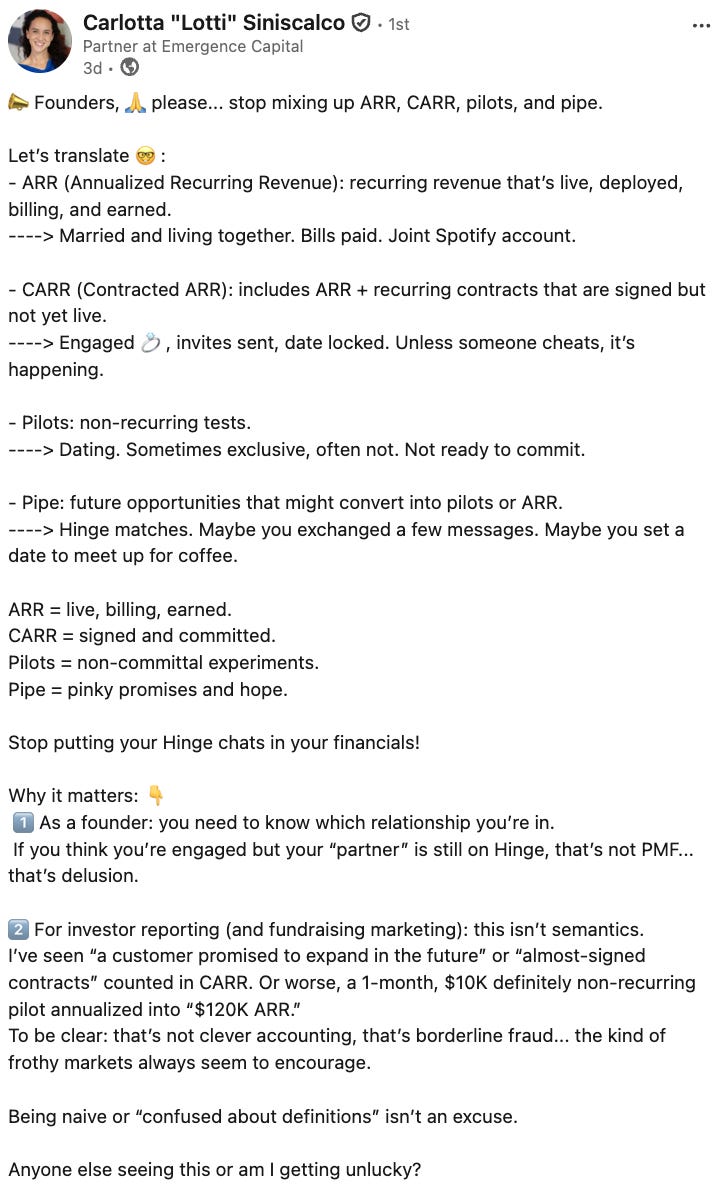
This is the Jason Kapono Problem.
We assume that more data means less potential.
We assume that the known quantity has no more leap in them.
We assume that the mystery box is the only box worth bidding for.
But history keeps showing the opposite, too
Steph Curry stayed in college two extra years.
Damian Lillard stayed four.
Both arrived with more tape than scouts wanted and more questions than they deserved.
Both became superstars anyway.
Mastery can bloom late.
Potential is not only a trait of the unproven.
And in markets like this, the companies with real depth might be the ones with the real runway.
So what are we actually optimizing for?
When investors overvalue mystery, we stop asking the harder questions.
Is the product used every day?
Does the revenue come from real customers doing real work?
Is the problem painful enough to justify a durable price?
Does the founder have the resilience to adjust when the hype cycle fades?
Are we looking at someone who has already proven they can win?
These questions matter more now in the AI era, where cycles compress every six weeks and the market rewards the hottest unknown long before it rewards the proven operator.
The Kapono-type companies are not boring.
They are the ones with the highest learning velocity.
They have survived actual scrutiny.
They have customers who would be upset if the product disappeared.
They have the infrastructure to absorb scale.
They are not mysteries.
They are viable.
If you are a Kapono founder, here is my message
Do not contort yourself to look like a phenom.
Your tape is your advantage.
Your reps are your traction.
Your mastery is the value.
Jason Kapono played eight years in the league, won back-to-back three-point contests, and built a career on precision, consistency, and knowing his role.
Every team that overlooked him because he was too known missed out on what he actually brought to the table.
If the market is valuing you like a Kapono while you feel like a Curry or a Lillard, keep going.
Keep sharpening.
Keep compounding.
Keep stacking real customers, real revenue, and real usage.
The investors who recognize mastery will find you.
And those are the ones you want anyway.
Takeaways
Mystery gets overvalued. Mastery gets discounted.
More data should increase conviction, not reduce it.
Real revenue and real customers are not red flags. They are proof of resilience.
The biggest outcomes can absolutely come from the companies that have already shown who they are.
The Kapono founders of this era are the ones most worth betting on.
Invitation
If you feel like a Kapono founder in an AI phenom market, send me a note.
I want to hear your story.
You may be further ahead than you realize.