


A few years ago, I was catching up quarterly with a friend who was a VC based in Austin. We’d trade notes on deals we were seeing. Same cadence. Same markets. Same general stage.
A pattern started to emerge.
She’d bring up a company and say something like, “I love this, but the valuation is insane. It’s basically a coastal deal. Probably makes sense for you in San Francisco, but not for me.”
I heard some version of that sentence multiple times across 2020 and 2021.
And eventually I told her what had been quietly dawning on me.
There is no such thing as a coastal deal anymore.
A “coastal deal” is wherever Sequoia or Benchmark decides to invest.
If that’s San Francisco, fine.
If it’s Louisville, Little Rock, or Minneapolis, that’s fine too.
Once a top-tier founder is building something truly differentiated, geography stops being the defining variable. Capital, conviction, and speed take over.
The borders didn’t disappear overnight.
They just stopped mattering.
COVID made this obvious in hindsight. The moment investors realized they didn’t need a flight to issue a term sheet, regional advantage started to decay. Zoom didn’t just change meetings. It collapsed distance as a gating factor.
What used to be “our backyard” quietly became “anywhere with signal.”
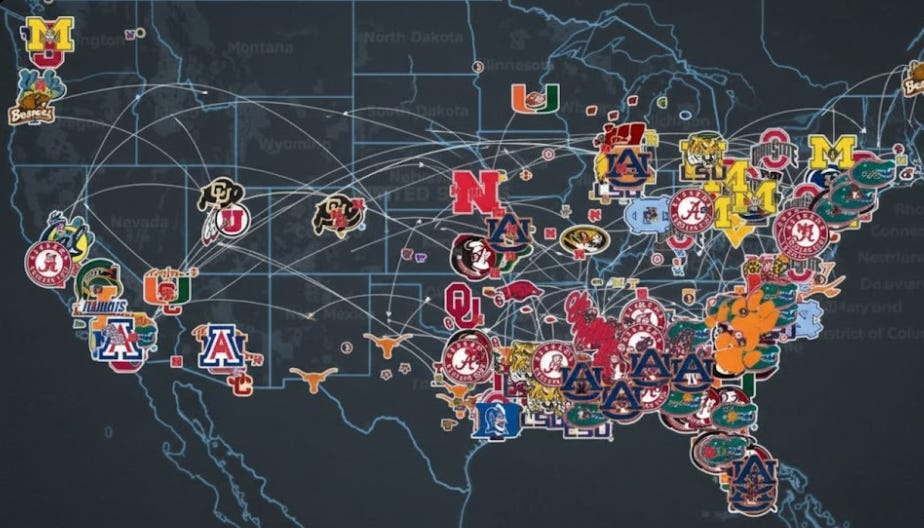
I started thinking about this again recently while watching what’s happened in college football.
Conference realignment and NIL didn’t just reshuffle logos. They erased the idea of protected recruiting territory. There used to be an assumption that certain programs would always dominate their regions. USC gets California. THE (so annoying) Ohio State gets Ohio. Georgia gets Georgia. Alabama gets Alabama. Florida gets Florida.
That logic doesn’t hold anymore.
Now it’s simpler and harsher. If you’re a top program, you recruit five-star and four-star players wherever they are. The internet exists. Money exists. Exposure exists. Borders are optional.
Venture works the same way now.
Regional access is not a moat. It’s a starting point at best.
This doesn’t mean place is irrelevant. Early incubation still has local texture. Communities still matter. Trust still forms in physical rooms.
But the idea that great outcomes are constrained by geography is a relic of a slower market.
What matters now is judgment.
Can you recognize real signal early?
Can you move with conviction before consensus forms?
Can you support founders when the path is still ambiguous?
Those questions travel far better than any ZIP code.
We didn’t lose regional advantage because Silicon Valley got greedy.
We lost it because speed, information, and ambition went global.
And once that happened, the game stopped caring where you were standing.
— e